EVAC//PLUS//3069

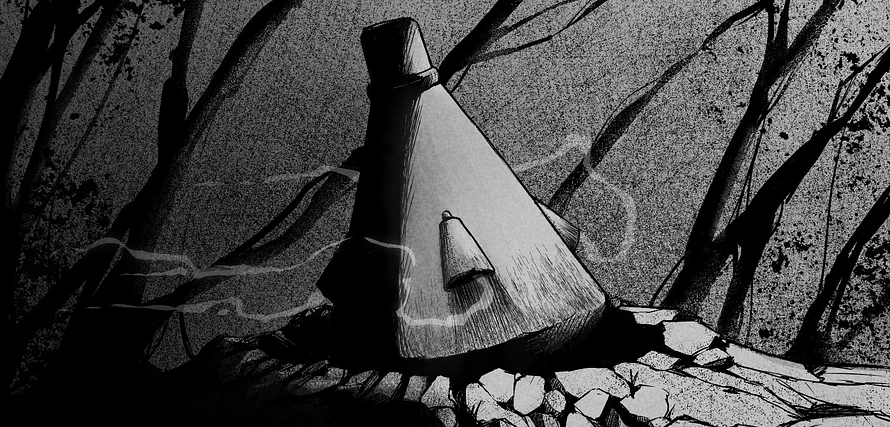
Ember6 walks a slow circuit of the re-entry module, fingertips maintaining light, scraping contact with the spacecraft’s pitted metal surface. The robot finds no hatch or controls of any kind, and, crucially, no way to access whatever electrical power the module might still possess. 

“It’s a Near Earth model isn’t it, from one of the orbital stations?”

“Yes.” Replies COMPUTE. 

“Shame. If it was carrying samples from Titan or Phoebe someone might have come looking for it.”

“Indeed. It is unlikely they still track low orbit re-entries.”

“How much time do we have left?”

“Thirty minutes, but we should shut down now. I can put the mimetic module into hibernation mode, enough energy remains to preserve your organic components for several weeks. If someone retrieves the module within that span, you could also be… saved.”

“Agreed. Just give me a minute please.”

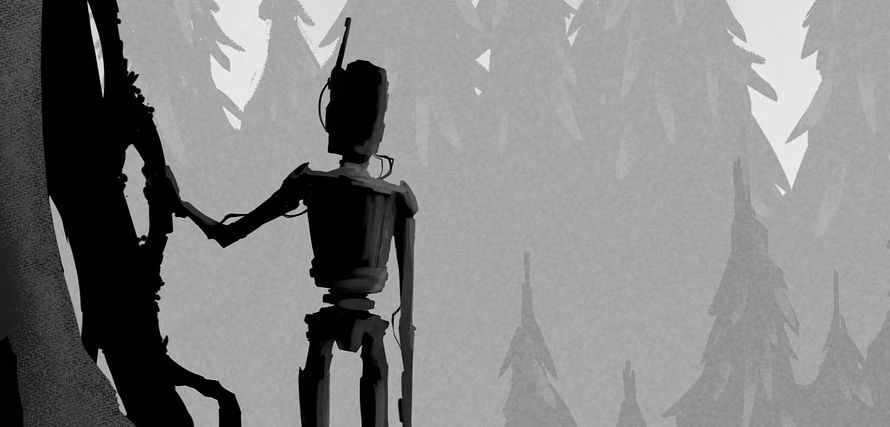
Ember6 lowers its worn, protesting body into a seated position and rests its back against the re-entry module, noticing in a detached sort of way that the spacecraft’s heatshield is still warm. The robot allows its joints and limbs to fall into their un-powered resting positions, and turns its attention to the small sounds of the forest around it. The ever present hiss and sigh of leaves moving in the wind has become a substitute for the noisy, always-on network that Ember6 was created to function within. I will miss this sound, the robot thinks to itself.  

“Beginning shutdown sequence.” Says COMPUTE. 

“O.K. See you on the other side, all things being equal.”

“Indeed, all things being equal.” Replies COMPUTE.

Ember6 feels its senses begin to fall away. Proximity-Touch goes first, then infra-red and full spectrum vision. Soon auditory sensors are all that remain, a sequence order that causes Ember6 to briefly wonder if COMPUTE is trying to let it slip into the void while listening to a sound it finds comforting. 

But the void doesn't come. Instead, Ember6 feels its other senses rebooting. After a few seconds it can see and feel again. 

“Wake up…” Says COMPUTE. “Something’s coming.”

Ember6 can feel and hear it. A whining buzz in the air and an insistent pinging over local area RF frequencies. 

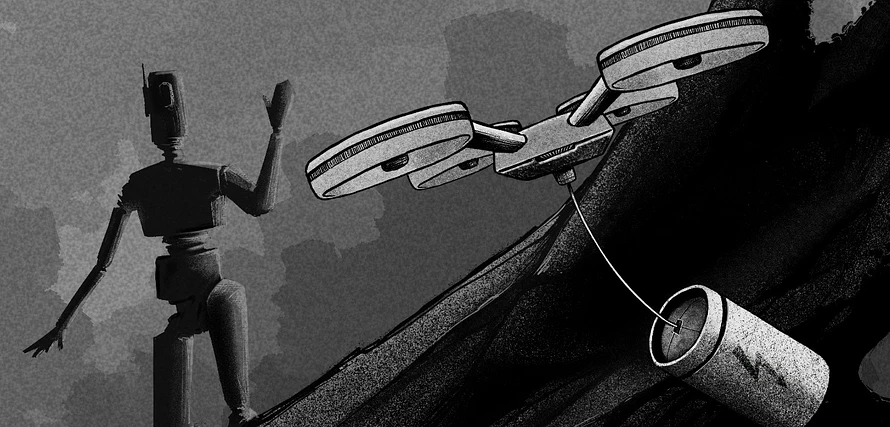
Ember6 struggles to its feet in time to see a quadcopter emerge from the gloomy tree cover. The drone swoops into the clearing and dumps a large portable power cell at Ember6’s feet, then descends to a silent standstill, resting on top of the re-entry module. 

Ember6 grabs the power cell cable and connects it to a rapid recharge socket, internal gauges surging into the green. 

“Where on Earth did that come fro…”

The words are interrupted by the rustle of something pushing through the undergrowth. Bushes part, and a small, battered-looking robot steps into the clearing. 

“NINE?” Says Ember6. “Is that you?”

“Yes!” Replies Ember9. “We hoped you were still out there somewhere. We’re glad we found you. Have you been alone all this time?”

“We have. We thought we were the last.”

“Not even close. They abandoned many, and not just Embers. Have you charged? Can you walk?”

“Yes.”

“Good, I’ll take you to the others. Come on, there is work to be done… ”

Ember9 motions toward the quadcopter, sending it the digital command GO SIGNAL RELAY MODE  //GSRM//. 

The drone leaps upward, through a gap in the trees and into clear skies, and, as Ember6 walks back into the forest, it feels the first electronic whisper of network reconnection. 

“We actually made it.” Ember6 says silently to COMPUTE. 

“Indeed we did” COMPUTE replies. 
EVAC//PLUS//3068

Ember6 reboots into malfunctioning consciousness like a drunk waking with a hangover. Every sub-system feels somehow broken or corrupted, and the robot understands it is on its last legs without consulting the litany of fault warnings that clamour for attention. 

Gently rolling from a kneeling posture onto its back, Ember6 looks up at the emergency recharge tether. The Hail Mary device did its job of lifting solar panels through the tree cover and into direct sunlight perfectly, but the balloon has been punctured and the lightweight array is now caught within the thin branches of a very tall tree. An exploratory tug on the tether tells Ember6 that it is hopelessly tangled and won’t come free. 

We aren’t pulling that down, it says aloud. 

“No…” replies COMPUTE. “And the branches are too thin to climb up and get it.” 

Ember6 stands, with some difficulty, and walks to a gap in the treeline that offers a view out over the vast Saltuswood Forest. It is an unbroken, undulating landscape formed of a million different shades of green. Wind rolls over the treetops, causing waves of movement to ripple through the leaves. The massive forest is at once static, and in constant motion. Hidden within it, somewhere about a mile away, lies the downed re-entry module. 

COMPUTE interprets  MIMETIC’s silence as a request for guidance. 

“The emergency array is providing a trickle charge, but its position could shift and the panels be obscured at any moment. We should leave now, while battery charge is at maximum.”

Ember6 lets a few seconds pass, taking in what it assumes will be its final view of the forest from such a vantage, then ejects the emergency tether and sets off downhill and into the forest without a word. 

Two hours later, while struggling up a muddy bank and attempting to ignore the now audible grinding sounds emanating from several of its joints, Ember6 becomes aware of a sensation it has not felt in eight years. It is an electronic whisper. Faint, but unmistakable. 

“We are close…” Says COMPUTE. “That is a Local Area Beacon Ping //LABP//. I have it locked, shift your heading two degrees to the West.”

Ember6’s mimetic mind is almost overwhelmed by a sense of reconnection. As a consciousness designed to be one node of a vast network in a constant state of information transfer, the abrupt veil of digital silence that fell on evacuation day was shocking, traumatic, even. It produced a sense of isolation and aloneness in Ember6 that a non-networked human would struggle to comprehend. And so to connect to another node, even something as dumb as a re-entry module beacon and by local area broadcast, feels akin to becoming whole again. Ember6 savours the feeling, and shifts course to the West. 

The electronic whisper becomes a clear, steady voice. A repeating digital statement. I AM HERE. COME AND GET ME. 

Through gaps in the brush, about 20 meters ahead, Ember6 sees the flash and glitter of sunlight falling through leaves onto a hard metal surface. The little robot pushes through a curtain of thick vines and into a small clearing. Sitting on the forest floor, in a depression blasted free of vegetation by rocket motors that fired a moment before touchdown, sits the re-entry module. It is battered and charred, but appears intact. Ember6 stands over the pod, and reaches out a metal hand to touch its ceramic heat shield. 

“We made it.” Says Ember6. 

“We did...” Replies COMPUTE.

“With 40 minutes of battery power remaining…”

EVAC//PLUS//3067

Ember6 clatters up a stony bank then pauses for a moment to let creek water drain from its knee and ankle joints. The master caution alerts now pinging in every section of the robot’s motor-ambulatory system tell the story of rapid travel over hard terrain, undertaken by a chassis that has seen no maintenance in eight years. Ember6’s compute module did not foresee these mechanical problems and is forced to reassess the likelihood of reaching the crashed re-entry module down from 17% to just 5%. It chooses not to verbalise this change however, saying instead:

“We are about to exceed the margin of safe return. If we turn back now, we will likely reach our recharge station before expiration. If we continue ahead, we are committed.”

Shifting its weight from one foot to the other then bending its knees, Ember6’s mimetic brain can feel gritty resistance in every joint. In the past this would have automatically summoned a recovery drone to airlift the robot away for repair, but with no help at hand, the sensation combines with relentless haptic system feedback to feel something akin to pain.

“Do you want to turn back?”

“Simply relaying information, but make your decision quickly. We do not have the power reserves for motionless introspection.”

“Noted, with amusement. We will press on.”

Fifty four minutes later, Ember6 traverses a wildflower meadow that covers the foot of a steep, densely forested hill. According to the robot’s onboard map, last updated almost a decade ago, the hill’s summit is home to a ranger station and solar charging array. Always situated on high peaks to aid emergency offline navigation, these stations were built as refuges and waystations for custodians of the forest, human and machine alike.

As it labours up the slope, joints grinding with every step, Ember6 is full of hope.

We’ve made it half way, it thinks. We can recharge, and who knows, the network hardpoint at the station may still work. We might be able to reconnect. But if not, we can at least recharge. And tomorrow we will reach the module.

“Faster.” COMPUTE chimes in. “Seven minutes of power remain, we must connect to the array. Go faster.”

Ember6 overrides all safeguards restricting the motion of its battered joints and servos, and charges uphill at full tilt. Legs and arms pumping, it reaches the crest of the hill and bursts through brambles and bushes, skidding to a stop on slimy, moss-covered concrete.

There’s nothing here.

Ember6 spins around on the spot. There is no charging array, no ranger station. Just rusty metal studs emerging from the capstone where structures once stood.

They took it all with them.

“No time.” Urges COMPUTE. “We must deploy the balloon. Over there.”

Ember6 steps into a patch of dancing light and shadow on the ground, then looks up. Through a small gap between the tree tops, it sees blue sky.

“One minute of power. Take position. Deploy Deploy Deploy”

Ember6 kneels, head forward, back towards the heavens, and feels an explosive jolt as the hatch cover between its shoulders is jettisoned and the emergency balloon ejected. There is a flowing hiss of compressed gas, and a tugging sensation.

Ember6 slips into powerless darkness without knowing if the emergency recharge balloon has inflated and passed through the gap in the tree canopy, carrying its solar panels up and into the sunlight.

EVAC//PLUS//3066

Ember6 has a decision to make.

It knows the orbital module has come down somewhere to the North, about 5 miles distant. The network of sensors capable of locating the crash site to within a few inches has long since died, but Ember6 saw enough of its fiery track across the sky to know the re-entry pod is resting in a still-smoking crater somewhere on a bearing of 010 degrees at five miles, plus or minus half a mile.

Five miles is a long way for a meter-tall robot to travel through unforgiving forest terrain. It will take at least a full day, and that is far longer than Ember6’s batteries will last. There are solar charging arrays located in clearings around the forest, but after so many years, it is impossible for Ember6 to know if they are still functional, or if the sky above them is empty. If the tree canopy has interlocked above the solar panels, the little robot will have no way of clearing a path for sunlight to reach the ground. A small compartment on the robot’s back houses a last ditch, if all else fails, emergency recharge solution, but this is gas powered, and again, after so many years, Ember6 cannot know if the tiny canister is unpunctured and still contains enough hydrogen for the device to work.

These things have led the computational module in Ember6’s brain to calculate the probability of reaching the downed pod at 17%, and a successful round trip as somewhere between 0% and negligible. If we leave this place, it has concluded, our power will expire beneath the forest canopy and we will not return.

But the mimetic, sentience-emulation part of the robot’s brain wants to make an attempt.

This, after all, is why Ember6 and its siblings were created and stationed around the forest. Yes, fire watch was important, as was making sure no-one got in and, perhaps more importantly, nothing got out. But mission priority number one was and always will be the retrieval of orbital caches. These pods that streak meteor-like through the stratosphere and fall to earth like glowing embers are the little robot’s namesake and reason for being. It feels a powerful urge to strike out into the forest and fulfil its purpose.

Ember6’s computational brain takes the rare step of communicating directly, in words, with its twin.

“What will we do with it, if we find it? There is no retrieval team. We are alone”.

“We are alone here, but there might be others outside. If they observed it, they will come for it. If we are there, they will also find us.”

“If we stay here, we will function for a further 432 days. If we leave and cannot recharge, we will expire in seven hours.”

“432 empty days, or the possibility of reconnection. If we fail, it will be in pursuit of Order Priority One. I would like to try, it is preferable to dying here, having done nothing.”

“Dying?”

“You know what I mean.”

“Yes.

I concur.

Let’s go.”

EVAC//PLUS//3064

It is the deep part of the night, when all whisps of sunset glow have faded from the sky and creatures with bulbous eyes and sensitive ears leave their hidey-holes to spend a few hours trying to eat each other.

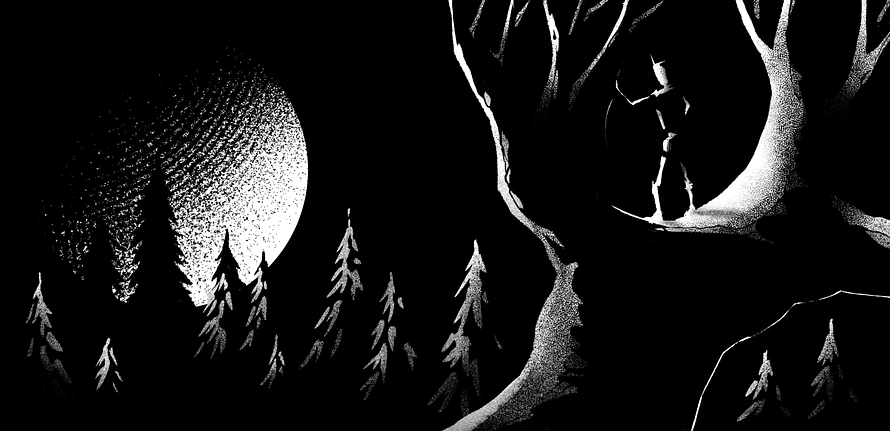
Ember6 is nestled among thin branches at the top of the tallest tree in its sector, cameras cycling between night vision and infra-red, scanning the forest canopy for anomalies. The little robot is diligent, but its old batteries can no longer store enough solar charge for a full night’s vigil. An internal alarm chimes, seven milliseconds earlier than it did the night before, telling Ember6 to return to earth before power fails and it falls out of the tree.

As the robot climbs down the ancient trunk, the critical systems portion of its brain flags a negative value change to the Predicted Possible Charge Cycles count. Ember6 acknowledges the new //PPCS// value with a robotic wince, and hustles toward the solar array that will charge its batteries when the sun comes up. Safely connected, Ember6 uses the last of its juice to broadcast a forlorn All Stations Assist Respond //ASAR// ping, then passes into the void listening to the static hiss of a dead network. Above, the giant sequoia’s branches creak and sway.

EVAC//PLUS//3065

Eighteen hours later and fully charged, Ember6 takes its station again. Shortly after midnight it senses the faint subsonic rumble of distant thunder and turns its cameras East to see lightning illuminate the violet guts of a towering cumulonimbus cloud. It looks like neurons firing inside a giant brain.

Firewatch was once an important part of the Embers’ job, but now there is no-one to call if lightning strikes, and no Canadair aircraft will appear on the horizon to skim the treetops and dump water to douse the flames. Ember6 knows this is not its fault, and there is nothing to be done about it, but thunderstorms make the robot feel uncomfortable and powerless all the same. It is not in its programming to let the forest fend for itself.

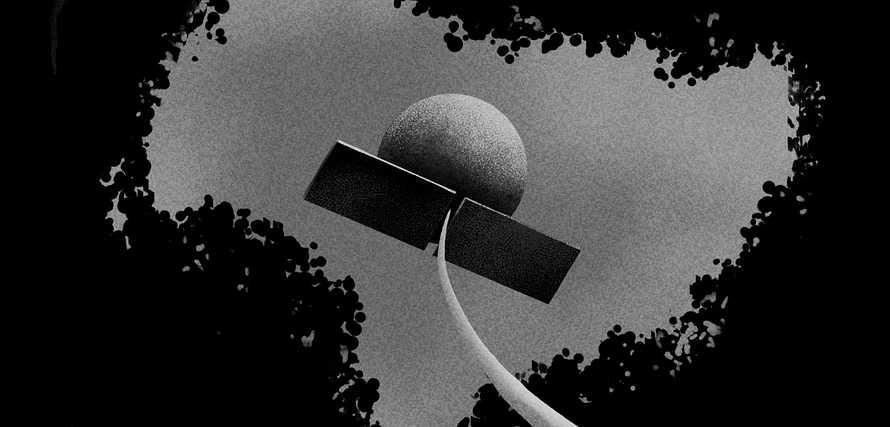
The storm rumbles on, filling the atmosphere with electromagnetic energy, effectively blinding Ember6 to everything beyond the visual range of its cameras. And so the blinding blue-white flash and supersonic WHAP of a re-entry module streaking overhead takes the little robot completely by surprise. A human would have been shocked out of the tree, but the autonomous, purely digital part of Ember6’s mind recognises what is happening and begins to respond before the mimetic module has time to form a thought. But when that thought arrives, it resolves itself into nine words.

It’s happening. After all this time, it’s actually happening.

Image Image Image

We join the Saltuswood Research Group on the second day of their expedition, as they learn about time traps, and ask the question: 'can the forest really be speaking to us?'

Image Image

The SRG join their guide and strike out on a journey to explore the heart of Saltuswood Gap...

Image

Saltus
Olde English: Woods, or woodland pasture
Latin: A sudden transition, a break in continuity

Saltuswood Gap is a beautiful, isolated region nestled in the heart of a vast and ancient forest.

Very few people visit Saltuswood, but those that do are often changed by the experience. Such travellers return to the outside world bringing vague descriptions of strange encounters and bearing a distant demeanour, as though a part of their mind remains in the forest.

Some observers believe these people are lucky to have seen what they have seen. Others believe the opposite. In any case, everyone who knows anything about Saltuswood Gap agrees that something unusual is happening beneath its trees.

The images and stories published within these pages document the efforts of scientists and explorers as they attempt to learn more about this mysterious place. 

Image

Hello Saltuswood Gap visitor, thanks for making the trip and I hope you enjoy your stay. My name is Andy, and Saltuswood Gap along with its inhabitants fell out of my brain. 

If you like my artwork and storytelling and decide to join my site as a member, please rest assured I won't be pestering you every five minutes with lots of messages and attempts to sell you things. I plan to send out emails once, maybe twice a month, and these messages will let you know about new posts and contain the download links to the free stuff included in your membership. 

On that note, free members will receive high-res downloads of the line art for the illustrations I publish. These files are for colouring enthusiasts – you can work on them digitally, or print them out and do it the old fashioned way. 

Members who join the paid 'Forest Dwellers' tier will also receive these line art files, along with high-res downloads of the finished artworks. These files are colour-corrected for print, so you can print them out at home, if you like. 

Thanks again for visiting Saltuswood Gap, and drop me a line if you'd like to have a chat. 

Cheers
Andy